Father Figure
A queer & trans perspective on family values, ancestral spirit, traditional practice, and honoring the models of our becoming.

This year marks the 25th anniversary of a long-beloved queer cultural relic called “Hedwig and the Angry Inch.” What began as an underground cabaret act in New York City in the mid ‘90s eventually became a touring stage show, then a film adaptation released in 2001, and in more recent years has run on Broadway with A-listers like Neil Patrick Harris and Taye Diggs stepping into the titular role. The show follows Hedwig, a self-proclaimed “internationally-ignored slip of a girlyboy” from East Berlin, as she tours with her glam punk band “The Angry Inch” and tells her story in song.
Hedwig is a sort of “biomythography”—to borrow from Audre Lorde—of her creator, John Cameron Mitchell, who also wrote, directed, and reprised the role in the film version. Hedwig’s story is a composite of bits and pieces from John’s personal life as a queer punk and Army brat inspired by the glam rockers like Lou Reed and David Bowie, then fictionalized to take on a life all its own. In the decades since John’s original performance, thousands of people of many genders and races and nationalities have now taken on the role of Hedwig. But no matter who wears Hedwig’s signature Farrah Fawcett wig, there simply would be no Hedwig without John.
I discovered Hedwig by way of a VHS box on display in the indie film section of my small hometown video store sometime around 2003. I eagerly brought that box home with me, and subsequently racked up a bounty of late fees. As a show, as a character, and as a cultural phenomenon, Hedwig bends the rules of gender and performance and love and power and freedom in ways my little queer heart had never before imagined. I watched it over and over again, soon memorizing each song and learning to play them on my guitar, each word and note working their way into my body and soul.
Queer theologian Gary David Comstock reflects on the role of “personal scripture” in one’s be/coming out. He suggests our criteria for what makes a story sacred to queer & trans life is not altogether different from what makes the Gospel sacred to a Christian. He writes, “These personal addresses and stories have the power to change how I relate to others, because having felt in them what it is like to be accepted, to belong, to be involved, I not only have a vision of how I want to live with others, I am not satisfied with anything short of it… They are a resource that builds expectations and shows me a new way to live in and change the world.”
Comstock suggests that the handing over of these stories creates a new kind of spiritual tradition; not one ensconced in formality, but curated, assembled, and passed down through our own personal and intimate exchanges. Like the passages and parables of the Holy Bible, these stories reflect a shared lineage of love, challenge, struggle, adventure, and divinity. Comstock continues, “I do not look for heroes, but simply find that household or neighborhood of ancestors with whom I can laugh, scream, argue, cry, and feel at home… I fit into a past that continues through me into the present.”
Queer & trans stories and cultural artifacts are passed down to us by the mentors we find in our queer & trans chosen families, shared together as rites of passage and critical moments of our be/coming out. The icons, characters, narratives, and aesthetics within these stories are the reflections of queer expression in which we recognize and nurture our own. Like Bowie made Hedwig in his image, Hedwig has made me in hers.
I’m one of thousands if not millions of queer people whose queer lives have emerged from Hedwig’s waters. But I bet I’m one of only a few who watched the Hedwig film in all its freaky queer punk glory and immediately thought, “I can’t wait to show this to my dad.”
My dad loved musical theater, and he loved rock and roll. He was a gifted actor and storyteller and singer and musician, though he’d never claim his talent as any more than mediocre. Not unlike Hedwig, he was something of a one-man show himself. I knew he would love Hedwig too. Surely not the same way I do, but in his own particular way. And sure enough, the Hedwig film and score soon became our shared treasures. Some of my sweetest memories of him in my teen years are of him asking me to play Hedwig songs on my guitar and sing to him.
When I told my dad I was starting hormone replacement therapy about 13 years ago, he lamented over what he thought was a missed chance to teach me the things a father is supposed to teach a son. He wondered and worried how I would make it as a man in this world without having received these lessons. He was afraid that I wouldn’t know enough about what it means to be a man to suitably “convince” the general population—which he somewhat rightfully interpreted to be a dangerous and bloodthirsty lot—and that missing these messages would ultimately come at the price of my own safety.
But there are at least two deeply significant truths that escaped his lamenting—the first being that he had already opted out of many obvious opportunities to pass these supposedly sacred lessons down to me. My proclivity toward masculine gender expression was nothing short of obvious throughout my childhood and teen years, well before I ever took a shot of testosterone. At eight years old, it was already bursting the seams of my white sateen First Communion dress obviously enough for my older sister to lean across the pew and remind me to walk down the aisle like a girl.
I started openly dating girls as early as middle school, and he never felt inclined to impart any wisdom there. He didn’t teach me how to use tools when I started wearing cargo shorts, and he didn’t offer to help me tie the rainbow polyester necktie I purchased from Hot Topic with my hard-earned babysitting dollars when he saw me struggling with it in the bathroom mirror.
He did, however, come to every one of my softball games, sitting in a camping chair, wearing a wide brimmed hat, slowly encircling himself with sunflower seed debris. When I walked up to the plate, he’d holler “Back up!” at a volume far exceeding that of the fielding team’s actual coach, and when I smacked the ball clear out of the park—as I was often wont to do—he’d shout “There it is!” while rising to his feet in a flash, dropping his bag of sunflower seeds to the ground to free up his hands for applause and screeching whistles through his thumb and forefinger.
I’m very aware that I’m one of the lucky ones. My dad loved me deeply, unconditionally, and recognizably. His expressed desire to participate in this leg of my becoming was endearing, hindsighted as it was.
I don’t blame him for not jumping at the opportunity to teach me these things. It’s not his fault he didn’t know how to raise a girl into a man. No one ever taught him how to do such a thing, and ultimately I don’t think he was the right person for that job anyway. I had to learn those lessons from my own queer kin, the ones who had already been to the particular places I needed to go, who were building their own lives there, had trail maps in tow, and could confidently brief me on the terrain.
The other truth my dad missed, which is the one I offered back to him in my reply that day, is that whether he shared these compulsory lessons of manhood with me intentionally or not, I still learned them—in no small part by his example, for better and for worse and for plenty of ways in between.
In his poem “Father’s Day for Gay Boys,” Dan Vera writes,
“We are not the sons they ordered
with their patriotic dreaming.
We are not the sons they expected to come down the line.
But we unfold
beyond such kind paternal ignorance.
We unfold within the measure of our time.
And we make peace with the fathers inside of us.
And we give birth to a hidden, long-carried joy within.”
One day my dad woke up and discovered he had lost coordination in one of his hands. Three years later—on Halloween night in 2020—he died of late-stage ALS.
John Cameron Mitchell is now 63 years old—just a year younger than my dad was when he died, and one of very few queer men currently living in their 60s. John is among the last of the lost generation of queer men and trans women who suffered to their death in the AIDS surge of the ‘80s and ‘90s while political authorities, religious leaders, and families and friends all turned their heads. Queerness & transness quickly became synonymous with disgust, panic, contagion, and death. As straight people ran as far from queer & trans people as they could, there was no one to care for the growing crescendo of violently and terminally ill people except other queer & trans people. We continue to play this role up close and personally as we are called to care for one another and show up for each other in intimate and vulnerable ways. In this queer mode of loving, we move beyond the relationship categories of friends or even lovers and well into the territory of family.
A dear friend of mine recently lost her grandmother, and she asked me what I think happens when we die. I told her that I believe in death we return to the oneness of all existence. Like pouring a glass of water into the ocean. What was once finite and contained has now been spilled back into the absolute immensity from which it came.
Wading in the waters of the holy queer spirit is how we honor queer life beyond the perils of death—not relegated merely to numbers in a toll but revered as the sacred beings we are, pieces of something so much larger than any one of us and so much more than just the sum of our parts. We keep the stories and traditions of our people alive as a practice of our freedom and as a pledge of honor to all those sacred beings that have carried and nurtured the holy queer spirit in our lives, especially those who have since been poured back into these glittering waters.
As he continued losing his coordination, my dad began giving me all the things he couldn’t use any more, whether I had use for them or not. First it was power tools (that, again, he had not taught me how to use), then it was cross country ski gear, and eventually—when he knew for sure he couldn’t use them anymore—his guitars.
Between the miracles of modern medicine and the natural patina of age, my body, face, and voice have all changed significantly over the past 13 years, and I find myself looking and sounding more and more like my dad with each passing year. I carry my body the way he carried his. My hands fall into the same gestures his once did. And I hear his voice burst past my lips with increasing frequency—especially when I’m behind the wheel of a car, or cooking meat over an open fire, or at a baseball game shouting “There it is!” as I jump to my feet. But never more clearly than when I’m singing with one of his guitars in my hands.
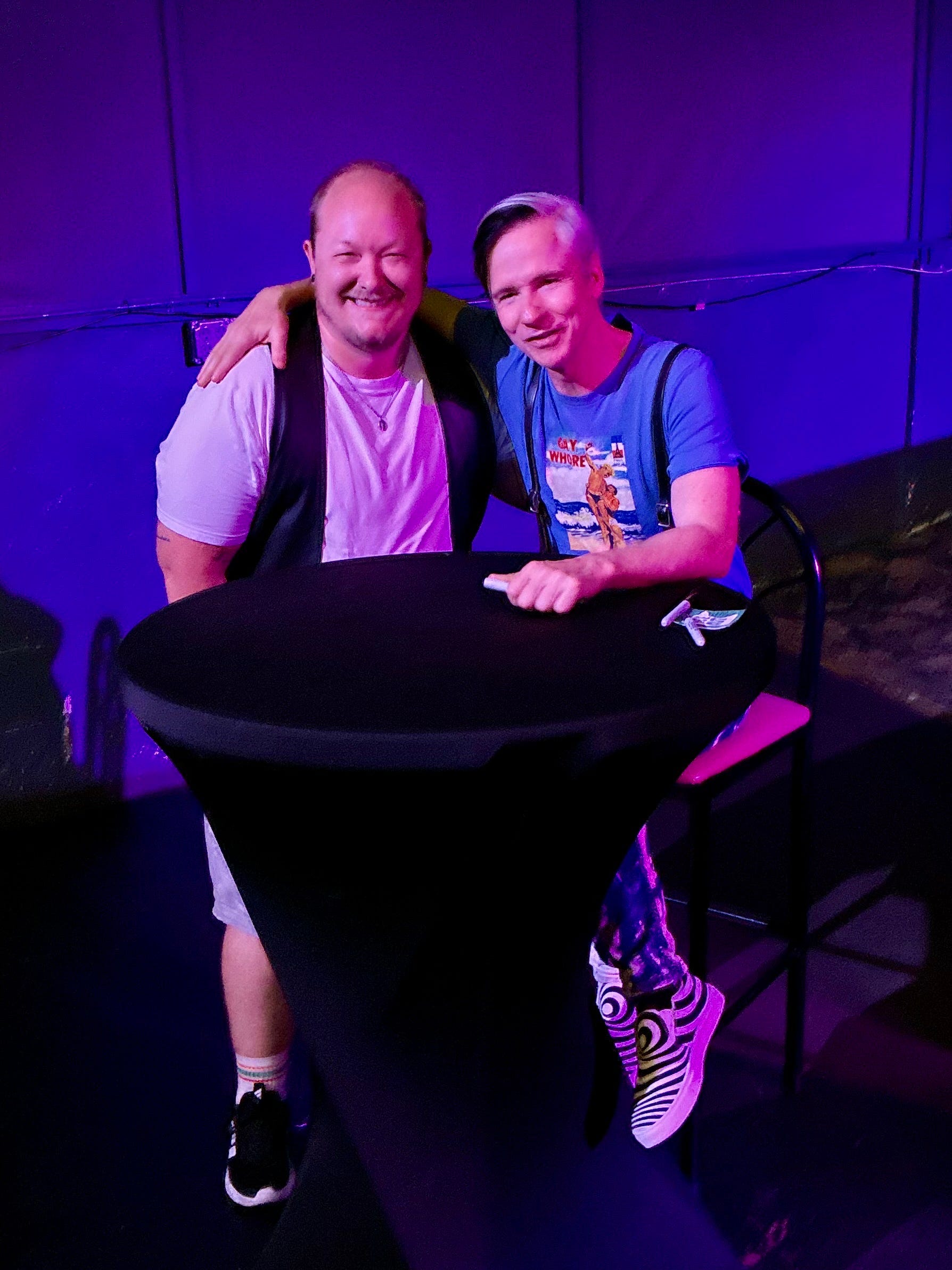
In honor of Hedwig’s 25th anniversary, John Cameron Mitchell just recently began an international tour of film screenings with Q&A sessions and mini acoustic sets of songs from Hedwig and other projects. The Minneapolis stop of the tour was this weekend, and I was fortunate to be in the first handful of rows at last night’s event. As John sang these songs I know and love so well, their words and melodies woven through my body and my soul, his smooth but aging voice filling my ears and the volume of our shared space, the sound soothed me like parent singing a lullaby—a deep and tender familiarity that has nurtured my very becoming.
That voice which is my father’s voice.
That voice which is my own.